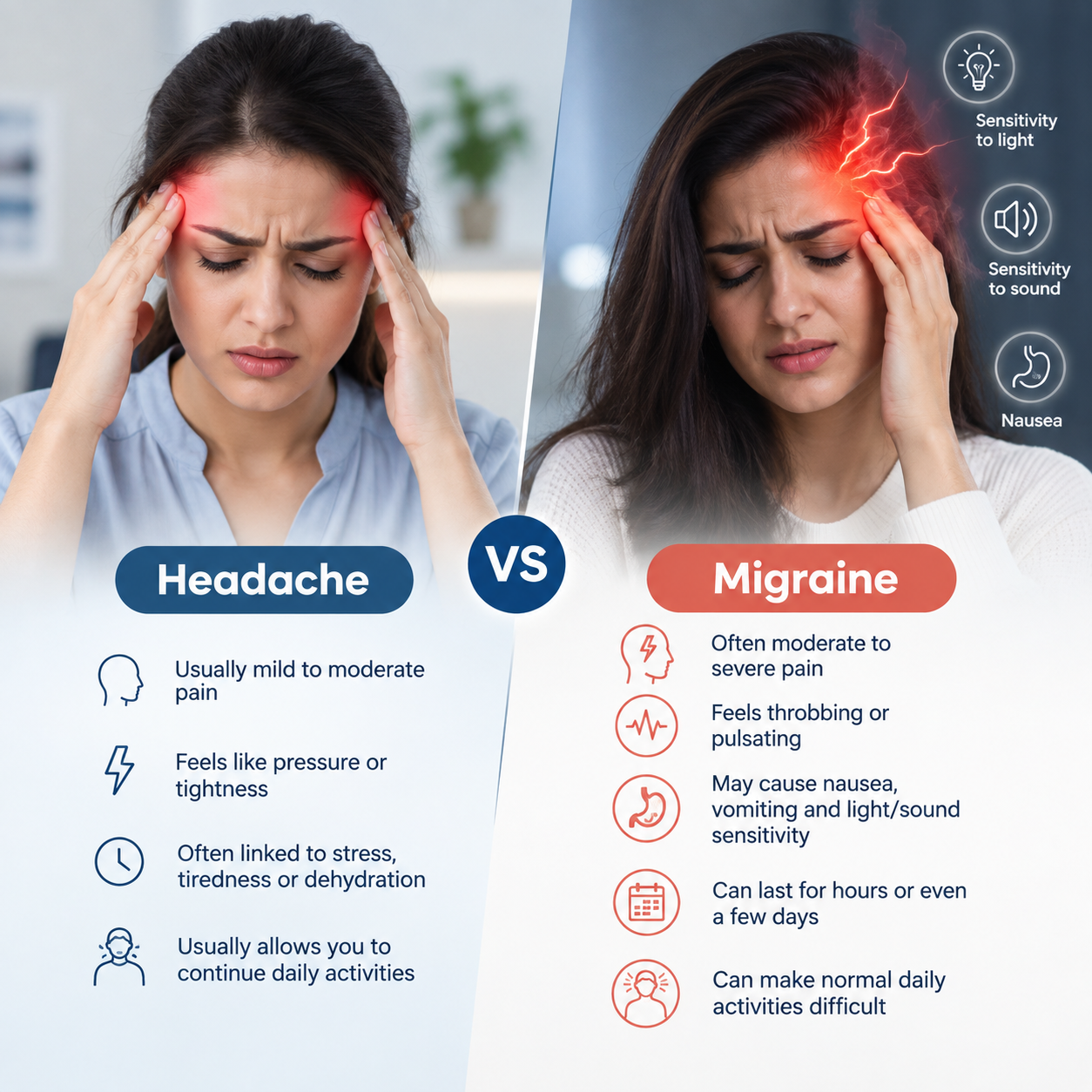
"Doctor, I have a headache" is one of the most common lines we hear in the OPD, and it usually covers a lot of ground. Some patients mean a dull ache after a long day at work. Others mean something that has kept them lying in a dark room for six hours, unable to look at a phone screen without wincing. These are not the same problem, even though people often use "headache" and "migraine" as if they were interchangeable. Knowing which one you're actually dealing with changes how you treat it, and more importantly, when you should stop self-medicating and get it checked.
What is a headache?
A headache, in the medical sense, is pain anywhere in the head or upper neck region. It's a symptom, not a disease in itself, and most of the time it's the body's response to something fairly ordinary — dehydration, skipped meals, too little sleep, hours in front of a screen, or plain stress. The most common type we see is the tension headache, which usually feels like a tight band squeezed around the head, dull and constant rather than sharp. It rarely stops someone from going about their day, and it usually settles with rest, water, or an over-the-counter painkiller.
What is a migraine?
Migraine is a different, and frankly more disruptive, condition. It's a neurological disorder, not just "a bad headache," and the pain is only part of the picture. A migraine attack typically causes a throbbing or pulsing pain, often on one side of the head, and it tends to come with nausea, sometimes vomiting, and an intense sensitivity to light and sound. Some patients also describe an "aura" beforehand — flashes of light, blind spots, or a tingling sensation — a warning sign that an attack is on its way. Where a headache might be a background irritation, migraine can be genuinely disabling, forcing people to cancel plans and lie down until it passes.
How to tell them apart
Patients often ask for a simple way to know which one they're dealing with. There isn't a single test you can do at home, but a few patterns usually give it away:
"If your head pain is one-sided, throbbing, and comes with nausea or light sensitivity, it's very likely a migraine rather than a regular headache — and it deserves a proper diagnosis, not just another painkiller."
What triggers each one
Headache triggers tend to be situational — poor posture at a desk, staring at screens for long stretches, dehydration, or a stressful week at work. Migraine triggers are more individual and, honestly, take some detective work to pin down. Common ones include hormonal fluctuations, irregular sleep, skipping meals, certain foods, strong smells, and bright or flickering light. Living in the Tricity, we also see a seasonal pattern — sudden heat, high humidity, and long commutes in traffic seem to bring on more migraine complaints during the summer months.
Treatment isn't the same either
This is where the distinction really matters. A tension headache usually responds well to rest, hydration, and a simple pain reliever. Migraine needs a more deliberate approach — identifying and avoiding personal triggers, maintaining a regular sleep and meal schedule, and in many cases, specific migraine medication rather than a generic painkiller. For people who get frequent attacks, we sometimes recommend preventive medication so the attacks don't keep interrupting work and daily life. Treating migraine like an ordinary headache — just popping a pill and waiting it out — is one of the most common reasons it becomes chronic.
When you should stop waiting it out
Most head pain is harmless and passes on its own. But a few signs mean it's time to see a doctor rather than reach for another tablet: headaches that are becoming more frequent or more severe, pain that wakes you up at night, sudden and unusually intense pain, or any headache accompanied by vision changes, slurred speech, or weakness on one side of the body. If your migraines are happening more than a couple of times a month, or medicines that used to work no longer help, that's also worth a consultation — chronic migraine is manageable, but it needs a proper treatment plan, not trial and error.
At Paras Health Panchkula, our Neuro Sciences team sees this exact question almost every week — patients unsure whether what they're experiencing is "just a headache" or something that needs real attention. If your head pain is frequent, severe, or getting in the way of your daily routine, don't wait it out on your own. A proper evaluation can tell you exactly what you're dealing with and the right way to treat it.