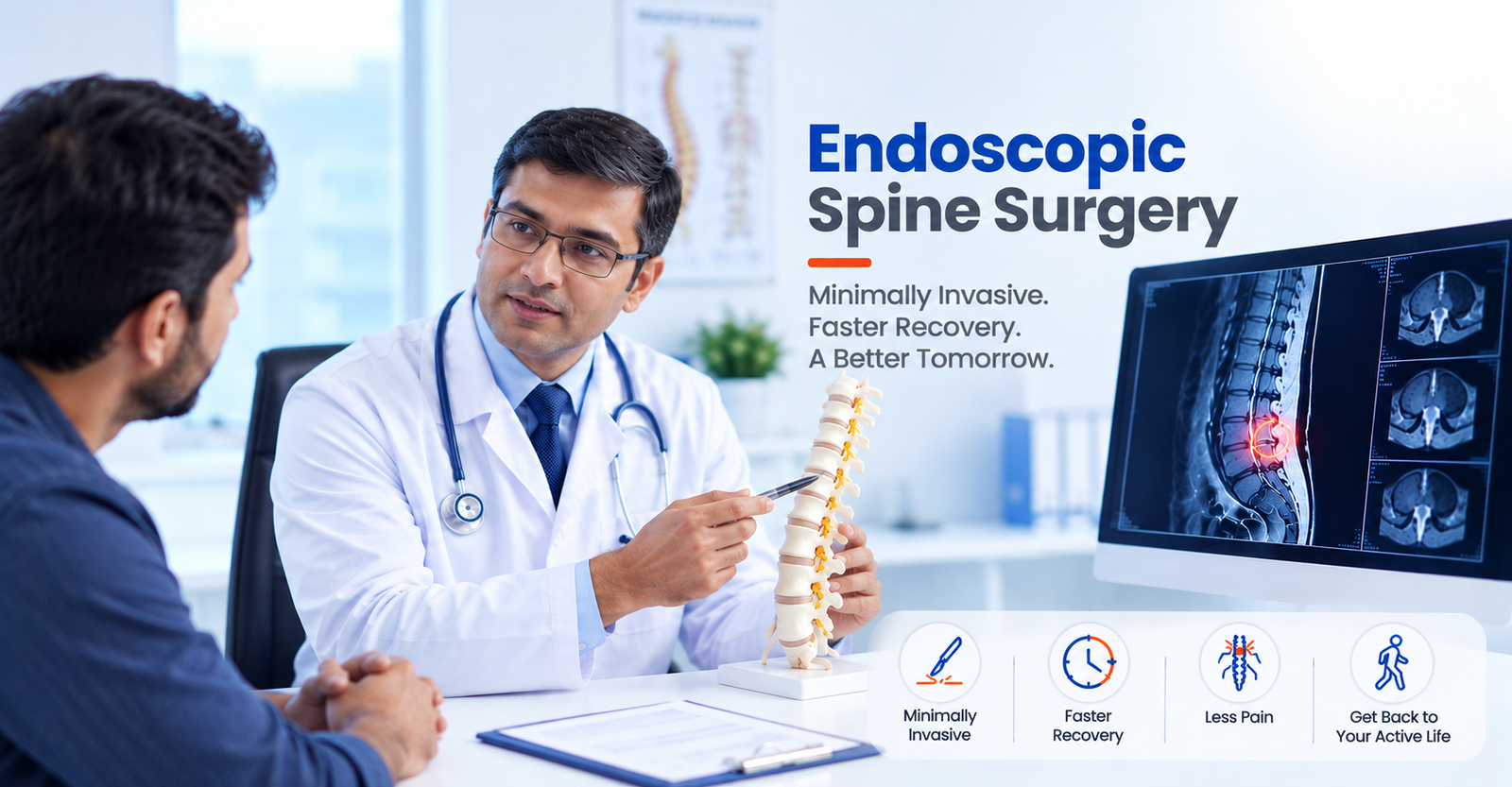
Back pain can slowly become part of everyday life—affecting sleep, work, walking and even simple movements. For selected spinal conditions that require surgery, an endoscopic approach may be considered after a careful clinical assessment.
Endoscopic spine surgery uses a specialised camera and fine surgical instruments to reach the affected area through a small access point. The technique is not appropriate for every spinal problem, so the choice of procedure depends on the diagnosis, symptoms, imaging findings and the patient's overall treatment needs.
Spine surgery is not about choosing the smallest possible approach. It is about choosing an approach that safely addresses the actual problem and makes sense for the individual patient.
Dr. Gaurav Sharma takes time to understand the patient's symptoms, examination findings and imaging before discussing treatment options. If endoscopic surgery is suitable, the procedure and expected recovery are explained clearly so patients can make an informed decision about their care.

Endoscopic techniques can be used for selected spinal procedures, particularly when the underlying condition can be appropriately reached through an endoscopic route. The exact surgical plan varies from patient to patient.
Dr. Gaurav Sharma has specialised training in spine surgery and experience in spinal decompression, fusion, deformity surgery and minimally invasive spine surgery. His approach is to match the treatment technique to the patient's condition rather than treating every case with the same method.
Endoscopic spine surgery is a minimally invasive surgical technique in which an endoscope—a thin instrument with a camera—is used to view and access the targeted area of the spine. Specialised instruments can be passed through the working channel to perform the required procedure when the condition is suitable for this approach.
Endoscopic surgery may be considered for selected patients with spinal conditions causing nerve compression or other problems that can be safely addressed through an endoscopic route. A diagnosis alone does not automatically mean that endoscopic surgery is appropriate.
Because the approach uses a small access point, selected procedures may involve less disruption to surrounding tissues than some conventional surgical approaches. Recovery can vary considerably depending on the condition, procedure, overall health and individual healing.
The decision begins with a detailed assessment rather than an imaging report alone. Symptoms, neurological examination, scans, duration of the problem and response to non-surgical treatment are considered. Where appropriate, non-operative options are also discussed.
Endoscopic surgery is one of several approaches available for treating spinal conditions. A conventional or other minimally invasive technique may be more appropriate when the anatomy, diagnosis or surgical goal requires it. The suitable approach is determined after evaluating the individual case.
Spine surgery requires careful attention to the nerves, spinal structures and the exact source of the patient's symptoms. Proper diagnosis and procedure planning are therefore important before selecting an endoscopic technique.
Dr. Gaurav Sharma is a Senior Consultant – Neurosurgery with over 14 years of clinical experience. His areas of expertise include specialised spine care, spinal decompression, fusion, deformity surgery and minimally invasive spine surgery. Patients can discuss their symptoms, reports and available treatment options during a detailed consultation.