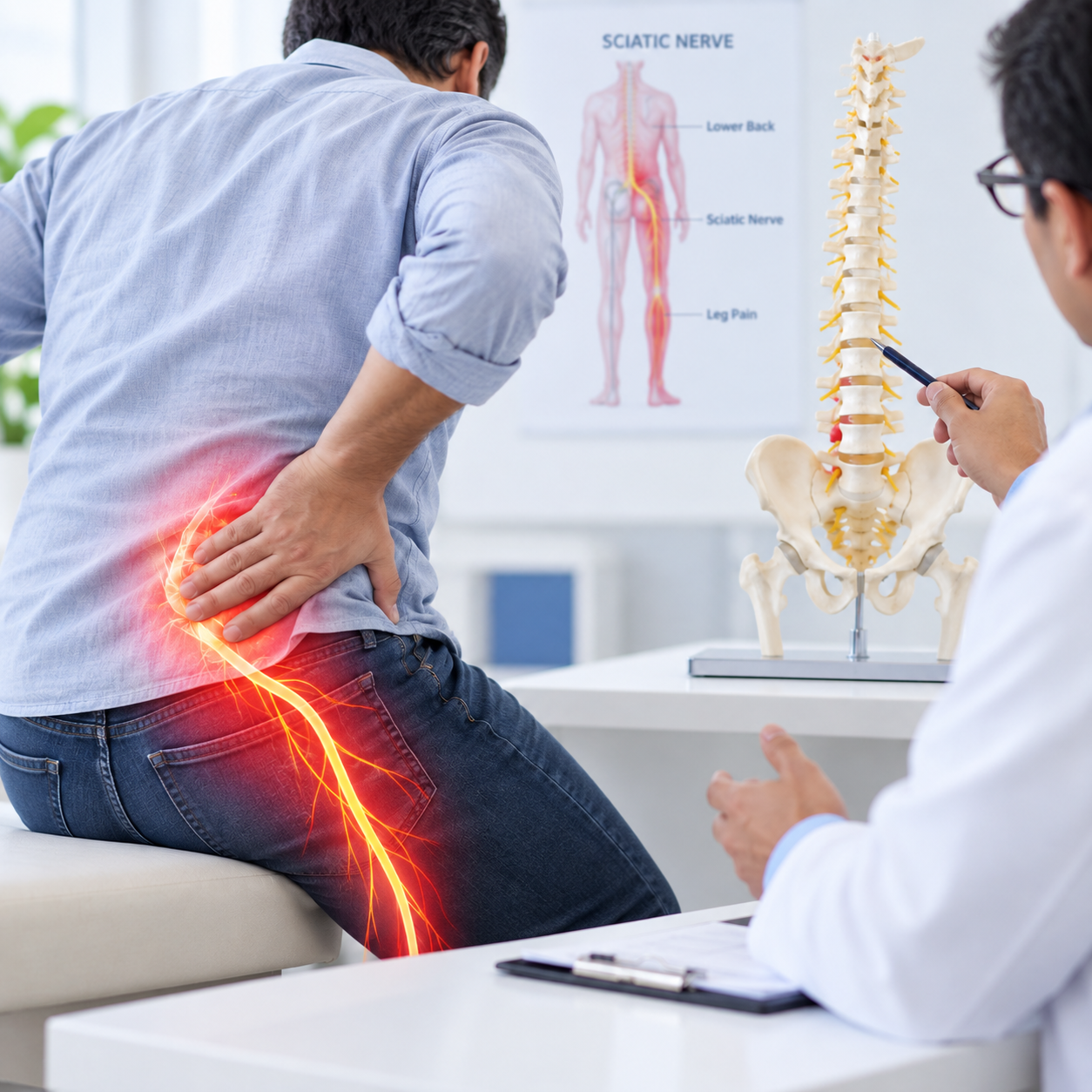
It usually starts the same way — a twinge in the lower back that, within a day or two, turns into a sharp, shooting pain running down one leg. Sitting becomes uncomfortable, standing up from a chair takes effort, and simple things like putting on socks start to hurt. Most patients who walk in with this complaint have already Googled it and arrive half-convinced it's something serious about their spine. Often, it's sciatica — and while the pain can genuinely be unbearable, the good news is that the large majority of cases get better without surgery.
What exactly is sciatica?
Sciatica isn't a disease on its own — it's what happens when the sciatic nerve, the longest and widest nerve in the body, gets compressed or irritated somewhere along its path from the lower back through the buttock and down the leg. Because the nerve runs so far, the pain doesn't stay confined to the back. It travels, and that travelling pain is really the giveaway sign. If the pain is one-sided, starts low in the back, and shoots down toward the foot, sciatica is almost always on the list of possibilities.
What does sciatica actually feel like?
Patients describe it in different ways, and honestly, all of them are valid — burning, an electric-shock sensation, a dull ache that won't let up, or a heaviness in the leg that makes it hard to walk normally. Numbness and tingling, especially in the foot or toes, are also common. Coughing, sneezing, or sitting for too long tends to make it worse, which is often what finally brings people in for a consult.
What causes it
The most common culprit, especially in younger and middle-aged patients, is a herniated or slipped disc pressing on the nerve root. In older patients, we see spinal stenosis — a narrowing of the spinal canal that comes with age-related wear and tear — playing a bigger role. There are a few other contributors worth knowing about: piriformis syndrome, where a tight muscle deep in the buttock irritates the nerve; general degenerative changes in the spine; and pregnancy, where the added weight and postural shifts can bring on sciatic symptoms. Long hours of sitting with poor posture — very common with desk jobs and long commutes around the Tricity — doesn't cause sciatica on its own, but it makes existing disc problems worse.
"Sciatica looks alarming because the pain travels so far from where the actual problem is. But in most patients, with the right combination of physiotherapy, posture correction, and a bit of patience, the pain settles down within a few weeks — without ever needing surgery."
How we diagnose it
Diagnosis usually starts with a clinical examination — checking reflexes, muscle strength, and how the pain behaves with certain leg and back movements. That alone tells us a lot. If the picture isn't clear, or the pain has been going on for a while, an MRI gives the clearest look at the disc and nerve roots. X-rays help rule out bone-related issues, and in select cases we use nerve conduction studies to see exactly how the nerve is functioning.
How sciatica is treated
This is the part patients are usually most relieved to hear: surgery is the exception, not the rule. Most cases respond well to a combination of anti-inflammatory medication for the acute phase, targeted physiotherapy to build core strength and correct the movement patterns that are aggravating the nerve, and simple measures like heat or ice application at home. For persistent inflammation, an epidural steroid injection can give significant relief while the underlying issue is addressed through therapy. Surgery — usually a microdiscectomy or laminectomy — comes into the picture only when pain has persisted for several weeks despite proper treatment, or when there's significant nerve compression causing leg weakness.
What helps at home
Gentle movement helps more than most people expect — complete bed rest tends to stiffen things up further. Short walks, knee-to-chest stretches, and piriformis stretches are usually well tolerated even during a flare-up. Sleeping on your side with a pillow between the knees takes pressure off the lower back, and alternating heat and ice packs can ease both the muscle spasm and the inflammation. What to avoid: heavy lifting, deep forward bends, and high-impact exercise until the acute pain has settled.
When it's time to see a specialist
Occasional back pain that eases with rest doesn't need urgent attention. But a few signs should bring you in sooner rather than later: pain that hasn't improved after two to three weeks, weakness in the leg or foot, numbness that's spreading, or — this one is genuinely urgent — any loss of bladder or bowel control. That last symptom needs same-day evaluation, as it can point to significant nerve compression requiring prompt treatment.
At Paras Health Panchkula, our Neuro Sciences team manages sciatica cases through the full spectrum — from physiotherapy-led recovery to surgical intervention for the small percentage of patients who need it. If lower back pain has started travelling down your leg and isn't settling on its own, it's worth getting it properly evaluated rather than waiting it out.