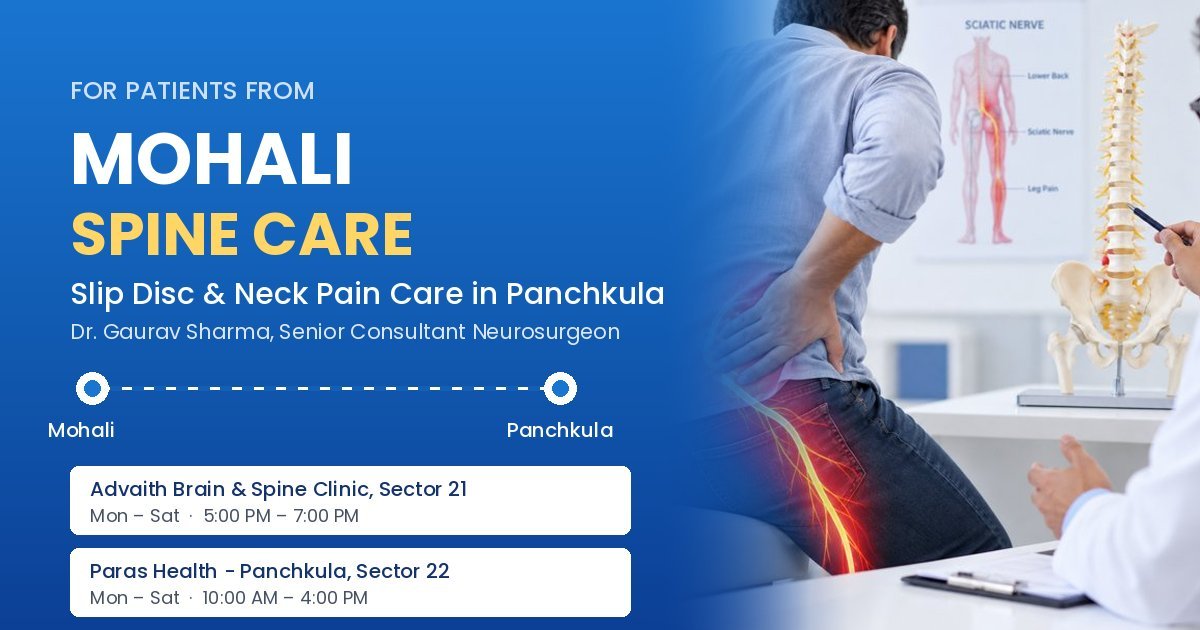
Mohali has two very different working worlds. In the IT City, Quark City and the offices around Phase 8B, people sit for long stretches in front of screens. In the industrial phases, workers lift, bend and stand on factory floors through long shifts. Both groups end up with spine problems, just of slightly different kinds.
Dr. Gaurav Sharma, Senior Consultant Neurosurgeon, treats patients from Mohali at Advaith Brain & Spine Clinic, Sector 21, and Paras Health - Panchkula, Sector 22. Depending on the phase, the drive is usually 30 to 45 minutes.
Typically at L4-L5 or L5-S1, with pain running into one leg. It often starts after lifting something heavy at work or at home, but it can also appear after weeks of poor sitting posture.
Neck pain spreading to the shoulder blade and arm, with tingling in the fingers. Common in people who look down at laptops or phones for hours.
Many younger patients have back pain without nerve involvement. They need posture correction and exercise more than scans.
A disc that has pushed out can shrink back over weeks. The plan usually starts with medicines for a short time, gentle walking, and physiotherapy focused on core and neck strength. For desk workers, small fixes go a long way: screen at eye level, feet flat on the floor, a lumbar cushion, and a short walk every 30 to 40 minutes. For factory workers, safe lifting technique (bending the knees, holding the load close) and avoiding twisting while carrying weight help prevent the next episode.
See a doctor quickly if the leg or arm becomes weak, if walking becomes unsteady, or if there is any bladder or bowel trouble.

When pain does not settle or weakness grows, surgery is discussed. For a single lower back disc, endoscopic discectomy removes the fragment through a small opening. For neck discs pressing on a nerve or the spinal cord, ACDF or disc replacement may be advised; this is explained on the cervical spine page. Patients with narrowing at several levels or a slipped vertebra may need minimally invasive decompression or fusion.
This is often the first thing Mohali patients ask. A rough guide, which is adjusted for each person:
A written note for your employer about light duties can be given at follow-up.
The evening clinic at Sector 21 (5 to 7 PM) suits people who cannot take a full day off. Follow-up visits are usually short, and earlier X-rays or MRI should be brought each time. If you are coming straight from work in Mohali, allow extra time for traffic on the airport road and around the Tribune Chowk.
General brain and spine information for Mohali residents is on the neurosurgeon near Mohali page.
Many patients from Mohali's IT companies are in their twenties and thirties. Their neck and upper back pain usually comes from long hours with the head bent forward, poor sleep and little exercise. An MRI is rarely needed at the start. What helps is a desk set-up that keeps the screen at eye level, a phone held up rather than looked down at, neck and shoulder strengthening, and a regular sleep routine. Pain that spreads into the arm with tingling or weakness is different and needs examination.
| Location | Days | Timings |
|---|---|---|
| Advaith Brain & Spine Clinic, 1842, Sector 21, Panchkula – 134112 | Monday – Saturday | 5:00 PM – 7:00 PM |
| Paras Health - Panchkula, near Nada Sahib Gurudwara, Sector 22, Panchkula – 134109 | Monday – Saturday | 10:00 AM – 4:00 PM |
| Panchkula OPDs | Sunday | By appointment |
Phone / WhatsApp: +91-9780703819
The OPDs are in Sector 21 and Sector 22, Panchkula, usually 30 to 45 minutes from most Mohali phases depending on traffic.
Yes. A cervical disc or bony spur pressing on a nerve can cause tingling in particular fingers. An examination helps confirm the cause.
Usually after about two to three months, built up gradually with a physiotherapist's guidance.
Yes. Advaith Brain & Spine Clinic, Sector 21 runs Monday to Saturday, 5 to 7 PM.